
Piano Scales and Arpeggios: A Comprehensive Guide
Discover essential piano resources! Explore scales, chords, and arpeggios in convenient two-page formats, alongside detailed guides. Find PDFs for all keys, aiding creative application.
What are Piano Scales and Arpeggios?
Piano scales are a sequential series of notes, typically within an octave, forming the foundation of melodies and harmonies. They establish tonal context and provide a framework for improvisation and composition. Arpeggios, conversely, present the notes of a chord played individually, one after another, rather than simultaneously. This creates a flowing, broken-chord effect, adding texture and color to musical passages.
Both scales and arpeggios are fundamental exercises for piano technique, fostering finger dexterity, coordination, and a deep understanding of music theory. Numerous resources, often available as PDFs, compile these exercises in all major and minor keys. These PDFs frequently include fingering suggestions, aiding in efficient and accurate execution. They often present scales and arpeggios in a convenient two-page layout, streamlining practice sessions.
Understanding the relationship between scales and arpeggios is crucial. Arpeggios are derived directly from the chords built within a given scale, reinforcing harmonic awareness. Accessing comprehensive piano scales and arpeggios PDFs is a valuable step towards technical proficiency and musical expression.
The Importance of Scales in Piano Technique

Piano scales are paramount for developing foundational technique. Consistent practice cultivates finger strength, independence, and evenness – essential for navigating complex repertoire. They build muscle memory, allowing for fluid and accurate execution without conscious thought. Furthermore, scales enhance coordination between hands, a critical skill for pianists.
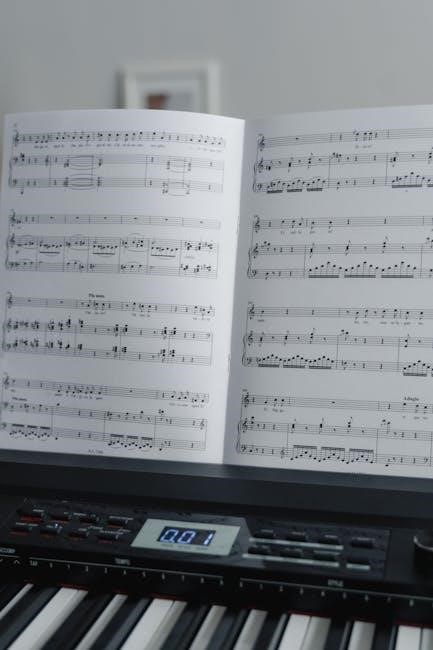
Beyond physical benefits, scales instill a profound understanding of key signatures, intervals, and harmonic relationships. This theoretical grounding empowers musicians to analyze and interpret music more effectively. Many resources, readily available as PDFs, offer structured scale practice routines, often including suggested fingerings for optimal efficiency.
These piano scales PDFs frequently present exercises in varying rhythms and articulations, challenging students to adapt and refine their technique. Mastering scales isn’t merely about rote memorization; it’s about internalizing musical patterns and developing a sensitive touch. Utilizing well-designed PDF resources accelerates this process, providing a clear path to technical mastery and musical expression.
Understanding Arpeggios and Their Role
Arpeggios, unlike chords played simultaneously, present notes individually, creating a flowing, harmonic texture. They are fundamental to piano technique, demanding precise finger coordination and control. Mastering arpeggios enhances hand independence and develops a nuanced understanding of chord voicings.
Their role extends beyond technical exercises; arpeggios frequently appear in musical compositions, adding elegance and depth. They serve as building blocks for improvisations and embellishments, allowing pianists to create expressive variations. Numerous piano arpeggios PDF resources offer structured practice routines, often categorized by key and chord type.
These PDFs typically include fingerings, rhythmic variations, and even exercises combining scales and arpeggios. Utilizing these resources allows for systematic progression, building both technical proficiency and musicality. Exploring dominant seventh arpeggios, often found in PDF collections, is crucial for understanding harmonic function and developing a sophisticated playing style. Consistent practice unlocks fluidity and expressiveness.
Major Scales: Construction and Fingerings
Major scales form the foundation of Western music, built upon a specific pattern of whole and half steps. Understanding this construction – Whole-Whole-Half-Whole-Whole-Whole-Half – is crucial for piano proficiency. Each major scale possesses a unique key signature, dictating sharps or flats. Mastering these scales unlocks harmonic understanding and improvisation skills.
Effective practice relies on consistent fingerings. Common approaches include the ‘thumb-under’ technique, promoting smooth transitions. Many piano scales PDF resources detail optimal fingerings for each key, often presenting two-octave and beyond patterns. These PDFs frequently include diagrams and annotations, clarifying hand positioning and finger placement.
Exploring piano scales arpeggios PDF collections often reveals integrated exercises, combining scale runs with corresponding chord progressions. This holistic approach reinforces both technical dexterity and harmonic awareness. Consistent practice, guided by reliable PDF resources, builds muscle memory and facilitates effortless scale execution across the keyboard.
Minor Scales: Natural, Harmonic, and Melodic
Minor scales introduce a nuanced emotional palette to piano playing, diverging from the brighter character of major scales. Three primary forms exist: natural, harmonic, and melodic, each with distinct intervallic structures. The natural minor scale maintains a consistent pattern, while the harmonic minor raises the seventh degree, creating a leading tone. The melodic minor alters both the sixth and seventh degrees when ascending, reverting to the natural minor form descending.
Many piano scales PDF resources dedicate sections to these variations, illustrating the differences visually and aurally. These PDFs often present all three forms side-by-side for comparative analysis, aiding comprehension. Understanding the subtle shifts in intervals is vital for interpreting and performing minor key pieces.
Comprehensive piano scales arpeggios PDF guides frequently include exercises that cycle through all three minor scale forms in each key. This systematic approach builds fluency and reinforces the unique characteristics of each variation, enhancing musical expression and technical control.
Scale Fingerings: Thumb-Under vs. Other Techniques
Piano scale technique hinges on efficient fingering. The “thumb-under” method, a cornerstone for many, involves passing the thumb under the hand to continue ascending or descending. However, it’s not universally applicable. Alternative techniques, like maintaining a consistent hand position or employing finger substitutions, address challenges posed by specific scales or hand sizes.
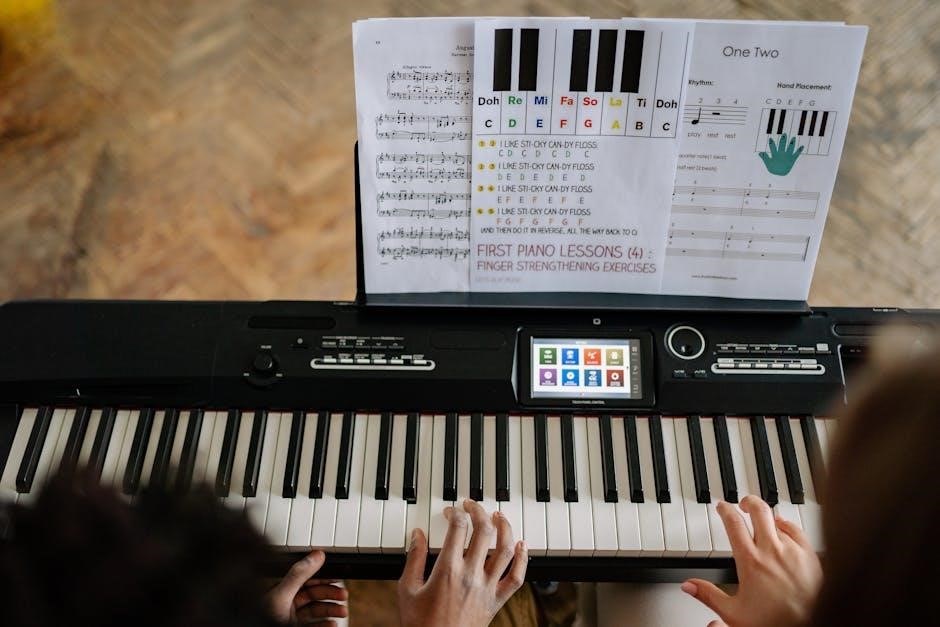
Piano scales arpeggios PDF resources often dedicate sections to fingering diagrams, illustrating both thumb-under and alternative approaches. These PDFs frequently highlight optimal fingerings for different scale types and octave ranges, promoting smooth transitions and minimizing tension.
Advanced piano learning materials may explore “grouping” fingerings, where patterns repeat across octaves, enhancing speed and accuracy. Detailed PDF guides will demonstrate how to adapt fingerings based on musical context and individual anatomical considerations, ensuring comfortable and effective practice.
Arpeggio Patterns: Common Fingerings and Variations
Piano arpeggios, unlike scales, demand a different fingering approach, prioritizing chord shape and smooth voice leading. Common patterns often utilize a 1-2-3-5 fingering for major and minor arpeggios, adapting as the hand ascends or descends. However, variations exist to navigate wider intervals or maintain legato phrasing.
Many piano scales arpeggios PDF resources showcase these patterns visually, providing clear diagrams for various arpeggio types – major, minor, dominant seventh, and diminished. These PDFs often include suggested fingerings for two-octave and beyond, emphasizing efficiency and musicality.
Exploring variations involves incorporating inversions and altering fingerings to create different textures. Advanced piano study materials, often available as PDFs, delve into these nuances, offering exercises to develop dexterity and harmonic awareness. Mastering arpeggio patterns unlocks expressive possibilities within repertoire.
Two-Octave Scales and Arpeggios
Two-octave scales and arpeggios represent a crucial stepping stone in piano technique, bridging the gap between basic one-octave exercises and more demanding larger forms. They build hand coordination, finger independence, and a foundational understanding of key signatures.
Numerous piano scales arpeggios PDF resources dedicate significant sections to two-octave patterns. These PDFs typically present scales ascending and descending, alongside corresponding arpeggios, clearly indicating suggested fingerings. The focus is on smooth transitions and consistent rhythm.

Many resources emphasize the importance of practicing two-octave forms with varying articulations – legato, staccato, and accented – to develop dynamic control. Finding comprehensive PDFs allows for structured practice, often including exercises for thumb-under technique and efficient hand positioning. Mastering these forms is essential for technical proficiency.
Three-Octave and Four-Octave Scales and Arpeggios
Three- and four-octave scales and arpeggios demand a higher level of technical skill and endurance than their shorter counterparts. They significantly enhance a pianist’s reach, fluency, and ability to navigate the keyboard with confidence. These extended forms require careful attention to hand position and efficient fingerings.
Locating quality piano scales arpeggios PDF materials is vital for mastering these advanced exercises. Many PDF resources offer detailed fingerings specifically designed for three- and four-octave patterns, often incorporating subtle shifts in hand position to maintain fluidity.
Advanced PDFs frequently include variations, such as scales in double thirds or sixths, alongside corresponding arpeggios. Consistent practice with these extended forms builds stamina and prepares pianists for tackling complex repertoire. Remember to prioritize accuracy and evenness of tone throughout the entire range.
Dominant Seventh Arpeggios
Dominant seventh arpeggios are crucial for understanding harmonic function and improvisational skills. These arpeggios, built on the dominant seventh chord, create a strong pull towards resolution, a cornerstone of tonal music. Mastering them unlocks a deeper comprehension of chord progressions and voice leading.
Finding comprehensive piano scales arpeggios PDF resources that specifically address dominant seventh arpeggios is essential. Many PDFs detail fingerings for various inversions, enabling smooth transitions and efficient practice. Look for materials that illustrate the relationship between the arpeggio and its corresponding chord.
Effective practice involves playing these arpeggios in all twelve keys, focusing on clarity and evenness. Advanced PDFs may include exercises combining dominant seventh arpeggios with other scales and chords, fostering harmonic awareness. Utilizing these resources will significantly enhance your musicality.
Resources for Piano Scales and Arpeggios PDFs
Finding quality piano scales and arpeggios PDFs is vital for effective practice. Numerous websites offer free and paid resources, catering to various skill levels. Many provide comprehensive collections covering major, minor, and chromatic scales, alongside arpeggios in multiple octaves.
Websites dedicated to music education frequently host downloadable PDFs. Look for resources that include suggested fingerings, clear notation, and potentially, practice tips. Some PDFs focus on specific techniques, like thumb-under passages, while others offer a broader overview.
Exploring online music stores and educational platforms can reveal professionally compiled piano scales arpeggios PDF workbooks. These often feature progressive exercises and detailed explanations. Remember to preview the content to ensure it aligns with your learning style and goals before purchasing.
Popular Piano Scale and Arpeggio Books
Several established piano books comprehensively cover scales and arpeggios, offering structured learning paths. Hanon: The Virtuoso Pianist is a classic, though primarily focused on technical exercises, it builds foundational finger strength crucial for scale mastery. Carl Czerny’s Practical Exercises for Beginners, Op. 599, introduces scales and arpeggios gradually.
For a more focused approach, explore books specifically dedicated to scales and arpeggios. Alfred’s Basic Adult Piano Course – Level One includes scale exercises, while Thompson’s Modern Course for the Piano offers progressive scale studies. These often include accompanying arpeggio patterns.
WP249 ー Scales, Chords & Arpeggios (Table Edition) presents scale, chord, and arpeggio studies in a convenient format. Many instructors recommend these books for their clarity and systematic progression. Consider supplementing book study with PDF resources for varied practice.
Using Apps for Scale and Arpeggio Practice (Simply Piano)
Modern piano learning increasingly incorporates apps like Simply Piano, offering interactive scale and arpeggio practice; These apps provide real-time feedback, guiding finger placement and rhythm. Simply Piano gamifies learning, making practice more engaging, particularly for beginners.
While apps excel at immediate feedback, they may not replace traditional methods entirely. Supplementing app-based practice with physical books and PDF resources can provide a more holistic understanding of music theory. Apps often focus on execution rather than the underlying harmonic principles.
Simply Piano’s advantages include its accessibility and convenience. However, accessing the full range of features often requires a subscription. Explore free PDF scale charts alongside the app to reinforce concepts. Consider the app as a tool to complement, not replace, comprehensive piano study.
Historical Context of the Piano and its Terminology
The piano, originally the “pianoforte,” emerged in the early 18th century, evolving from the harpsichord. Its ability to vary dynamics – “piano” (soft) and “forte” (loud) – distinguished it. Early piano technique emphasized ornamentation and improvisation, with scales and arpeggios serving as foundational exercises for developing dexterity.
As piano repertoire expanded, so did the need for standardized scale and arpeggio practice. Composers like Czerny and Hanon created systematic exercises, often compiled into instructional books and, later, accessible PDF formats. These resources aimed to build technical proficiency.
The terminology surrounding scales and arpeggios reflects this historical development. Understanding the origins of terms like “dominant seventh” or “harmonic minor” enriches musical interpretation. Numerous historical PDFs detailing these concepts are available, offering insight into evolving pedagogical approaches. Studying these resources provides context for modern practice.
Applying Scales and Arpeggios to Repertoire
Mastering scales and arpeggios isn’t merely a technical exercise; it’s a gateway to unlocking musical expression within repertoire. Identifying the underlying scales and arpeggios within a piece illuminates harmonic structure and facilitates memorization. Recognizing patterns streamlines learning and enhances performance.
For example, a Chopin nocturne might heavily feature arpeggiated figures based on dominant seventh chords. Practicing those specific arpeggios beforehand builds fluency. Many PDF resources categorize scales and arpeggios by key and harmonic function, aiding this analytical process.
Furthermore, applying scale and arpeggio patterns to improvisation fosters creativity. Utilizing PDF practice materials, musicians can transpose exercises into different keys, mirroring the demands of diverse compositions. This targeted approach bridges technical drills and artistic interpretation, transforming rote learning into musical understanding.
Practice Tips for Efficient Learning
Efficient scale and arpeggio practice demands focused attention and strategic planning. Begin slowly, prioritizing accuracy over speed. Utilize a metronome to build consistent rhythm and gradually increase tempo. Short, frequent practice sessions are more effective than lengthy, infrequent ones.
Leverage PDF resources offering varied fingering patterns. Experiment with different approaches – thumb-under, for instance – to develop dexterity and adaptability. Don’t limit practice to ascending and descending patterns; incorporate broken chords and inversions.
Many PDF guides include suggested practice routines. Supplement these with self-designed exercises targeting specific weaknesses. Record yourself playing and critically evaluate your technique. Finally, remember to apply learned scales and arpeggios to actual repertoire, solidifying your understanding and musicality. Consistent, mindful practice yields the greatest rewards.
Leave a Reply
You must be logged in to post a comment.